
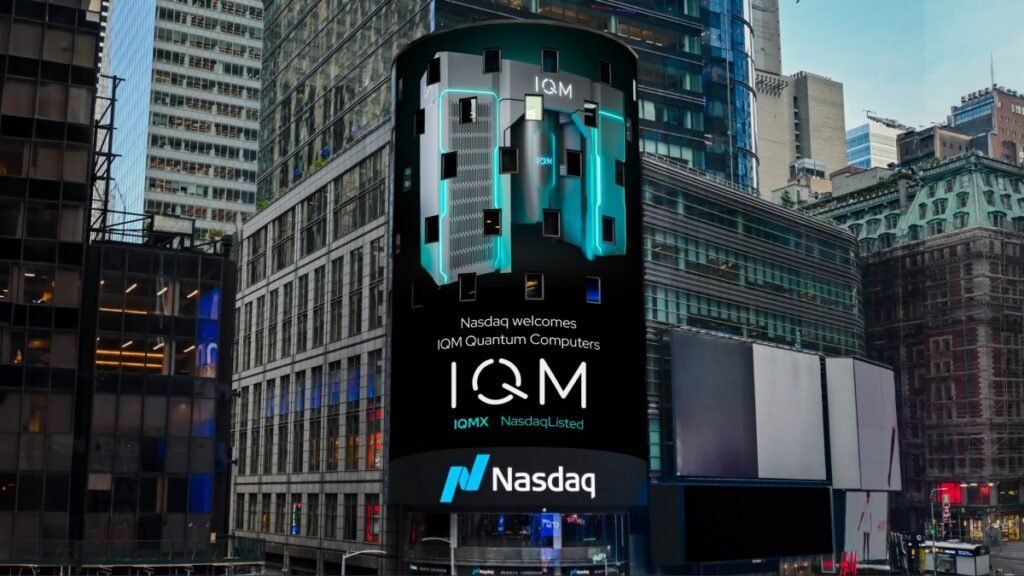



Finnish full-stack quantum pioneer IQM officially hit the Nasdaq on Thursday, marking a milestone as the first European quantum computing firm to list on a major U.S. exchange. The company debuted via a SPAC merger at a valuation of approximately $1.9 billion, yet the market response was muted; shares spent the majority of the trading day hovering below the IPO price, signaling investor hesitation toward the sector.
The Reality Check: Is Quantum Commercialization Real?
While SPACs often face skepticism from retail investors, the lukewarm debut was likely exacerbated by a candid admission in IQM’s own prospectus. The company explicitly warned that “large-scale commercial traction of quantum computing technology may never occur.”
Although this disclaimer is standard across the quantum industry, it underscores the current speculative nature of the field. Nevertheless, IQM continues to secure tangible business. By selling physical quantum hardware and cloud-based computing time, the company has built a client base that includes the VTT Technical Research Centre of Finland and Germany’s Leibniz Supercomputing Centre.
“We sell computers into advanced supercomputing centers and data centers, and we sell computing time through the cloud,” CEO and co-founder Jan Goetz told TechCrunch.
Scaling Toward the “Quantum Advantage”
IQM has seen its client list expand from eight in 2024 to 22 in 2025, a growth trajectory that includes recent private-sector acquisitions. However, widespread adoption remains tethered to the elusive “quantum advantage”—the point at which quantum chips consistently outperform classical systems in complex tasks like biotech simulations, fintech modeling, or advanced encryption. Currently, no player in the industry can predict exactly when this shift will occur.
Geopolitical Tailwinds and U.S. Expansion
Despite the long-term uncertainty, investor appetite remains robust, bolstered by President Trump’s recent executive orders aimed at accelerating quantum development. The U.S. Department of Energy (DOE) has set an aggressive target to deploy the world’s first fault-tolerant, scientifically relevant quantum computer by 2028.
var playerInstance_jwplayer_6a794a71aac97 = jwplayer( “jwplayer_6a794a71aac97” );
playerInstance_jwplayer_6a794a71aac97.setup({
playlist: “https://cdn.jwplayer.com/v2/media/lv0GaEwB”,
});
For IQM, these policy shifts are actionable. The company has already established a quantum technology center in Maryland and successfully deployed a system at Oak Ridge National Laboratory, which operates under the DOE. “We can benefit directly from it,” Goetz noted.
A European Soul with Global Ambitions
Unlike many European unicorns that migrate their operations to the U.S. market, IQM maintains a strong European footprint. Following its U.S. listing under the ticker IQMX, the company is set to debut on Nasdaq Helsinki, retaining the backing of institutional players like Tesi, Finland’s sovereign wealth fund.
Founded in 2018 as a spinout from Aalto University, IQM retains deep Finnish roots, with two-thirds of its 420-person workforce based in Espoo. The remainder of the team operates out of Munich and other international hubs to facilitate global deployment.
The RAAQ board, which facilitated the SPAC, noted that IQM’s ability to navigate both European public support—totaling over €200 million—and international operations made it an attractive candidate for the public market. While Goetz takes pride in being the first European quantum firm to list in the U.S., he remains focused on the bigger picture. The IPO will inject roughly $226 million in new liquidity into the company, providing the necessary runway to compete in a race defined by high stakes and unknowns.



Leave a Reply