
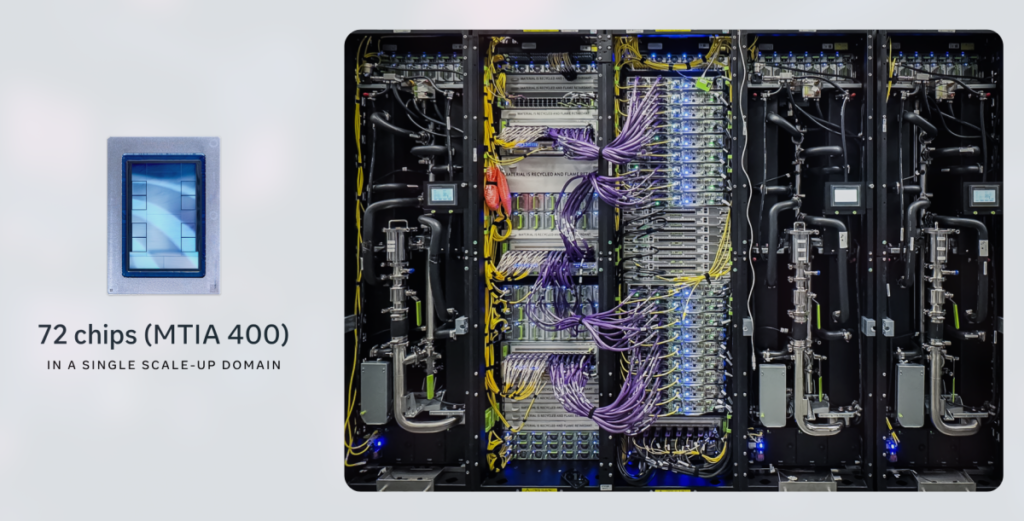



Meta is set to begin production of its latest AI-specific processor this September, according to an internal memo reported by Reuters. The move aims to alleviate the company’s massive GPU expenditures amid an ongoing global component shortage.
Strategic Partnerships and Production
The memo reveals that at least one chip design successfully passed its testing phase in approximately six weeks. While Meta is collaborating with Broadcom on the architecture, the physical manufacturing will be handled by Taiwan Semiconductor Manufacturing Company (TSMC). Additionally, the supply chain involves sourcing RAM from Samsung, storage components from Sandisk, and fiber-optic equipment from Sumitomo Electric.
The Evolution of the MTIA Program
In March, Meta detailed four new processors developed under its Meta Training and Inference Accelerator (MTIA) program. Some of these units are already being deployed, with others scheduled for rollout through next year. The company is utilizing a modular design approach to ensure the hardware can adapt to the rapid pace of AI advancement. “Each MTIA generation builds on the last, using modular chiplets, incorporating the latest AI workload insights and hardware technologies, and deploying on a shorter cadence,” the company noted.
Reducing Dependence on Nvidia and AMD
Although Meta expects to continue significant spending with third-party providers like Nvidia and AMD, these internal chips are designed to handle training for ranking and recommendation algorithms, as well as broader AI inference tasks. Meta has been producing its own AI chips since 2023.
Massive Infrastructure Investment
Meta’s capital expenditure for 2026 is projected to fall between $125 billion and $145 billion, with a substantial portion dedicated to AI infrastructure. In April, the company confirmed these financial expectations. To power its upcoming Muse Spark AI models, the company is finalizing global data center and power deals, aiming to deploy 7 gigawatts of compute this year and double that capacity in 2027.
Broadening the Hardware Ecosystem
Meta’s strategy includes diverse hardware partnerships. Beyond its internal efforts, the company signed a deal with ARM last year to support its recommendation systems. It also maintains multibillion-dollar agreements with AMD for Instinct GPUs and Amazon to utilize the cloud giant’s proprietary CPUs.
The Shift Toward Custom Silicon
Meta is part of a broader trend of tech giants seeking to reduce reliance on Nvidia. OpenAI recently unveiled plans for an inference processor developed with Broadcom, while Anthropic is reportedly considering a partnership with Samsung for custom silicon. Amazon and Google continue to refine their own training and inference chips, joined by a growing number of startups entering the space to address the surging demand for AI computing power.
Meta declined to comment on the report.



Leave a Reply