
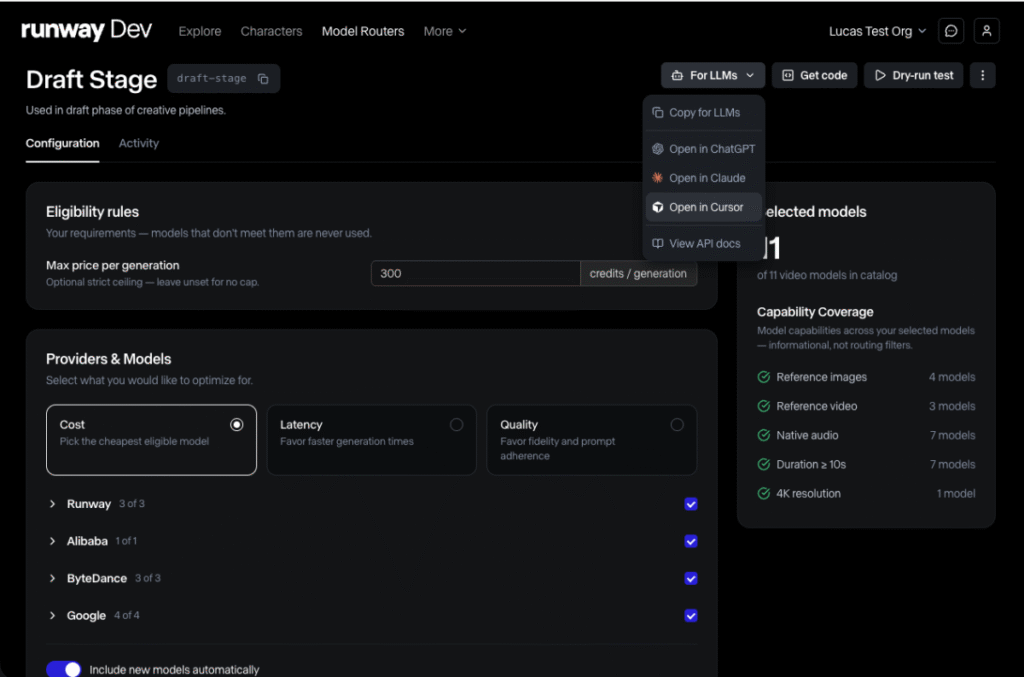


Runway is pivoting from a standalone AI model provider to the foundational infrastructure for generative media. On Thursday, the startup officially launched the Runway Media Router via Runway Dev, a developer platform that grants API access to a curated selection of third-party audio, video, and image models alongside Runway’s proprietary technology.
Intelligent Routing for Generative Media
The Media Router is designed to automatically select the most effective model for any given request, basing its decision on a developer’s specific priorities: quality, speed, or cost. While model routers have become standard in the large language model (LLM) space, Runway claims this is the first system built specifically to navigate the complexities of generative media.
“The routing really fits into that overall promise of being the easiest one-stop shop for developers to integrate with any type of generative media model,” Anthony Maggio, Runway’s chief product officer, stated.
Expanding the Developer Ecosystem
This launch marks a strategic evolution for Runway, positioning it as an essential infrastructure provider for major companies. Current customers utilizing Runway Dev to embed media generation directly into their products include Adobe, Cloudflare, ElevenLabs, Expedia, Shutterstock, and Quora.
The router addresses a significant pain point for developers: the overwhelming influx of new generative models. Instead of manually evaluating which model performs best for specific outputs—such as motion in video or composition in images—developers can rely on Runway’s internal intelligence layer. This layer leverages the expertise of Runway’s creative team, who continuously evaluate models based on real-world performance metrics.
Customizable Preferences and Geopolitical Constraints
The tool also allows for nuanced customization. Beyond cost and quality, developers can set preferences based on regional origin. As scrutiny grows around Chinese-developed models, businesses can opt to prioritize American model providers—a feature likely to gain traction as the Trump administration explores potential sanctions or bans on foreign open AI models.
Maggio noted that managing token pricing is another primary driver for adoption, especially as enterprises look to control the high costs associated with agentic AI workflows. The router launch follows Runway’s recent transition to a token-based pricing structure for its own subscription plans.
Building on Proven Technology
The technology behind the Media Router isn’t new to Runway; it is the same orchestration engine the company developed for its agent product, a creative partner launched in May to automate the creation of multi-shot videos and marketing campaigns.
A Strategic Pivot in a Crowded Market
Runway’s shift reflects the intense fragmentation of the generative media landscape. While its Gen 4.5 model and the Aleph 2.0 video editing model have previously topped industry leaderboards—outperforming competitors like Google—the company faces stiff competition from heavy hitters like ByteDance and Alibaba.
By shifting to an orchestration layer, Runway aims to remain relevant even as the “best” model changes monthly. Anastasis Germanidis, Runway’s co-founder and co-CEO, emphasizes that as companies build complex, multi-scene campaigns, the orchestration of these models becomes as critical as the models themselves.
“You need great models underneath, but the orchestration increasingly matters a lot,” Germanidis explained. “It’s that intelligence layer that comes on top of the pure pixel models. The router is one way in which the benefits of that come to users.”
Maggio summarized the company’s long-term vision: “If you zoom out at the one thing Runway has been doing since 2018, it’s that we’re deeply focused on research, while building for where we think the space is going at the same time.”

Leave a Reply